
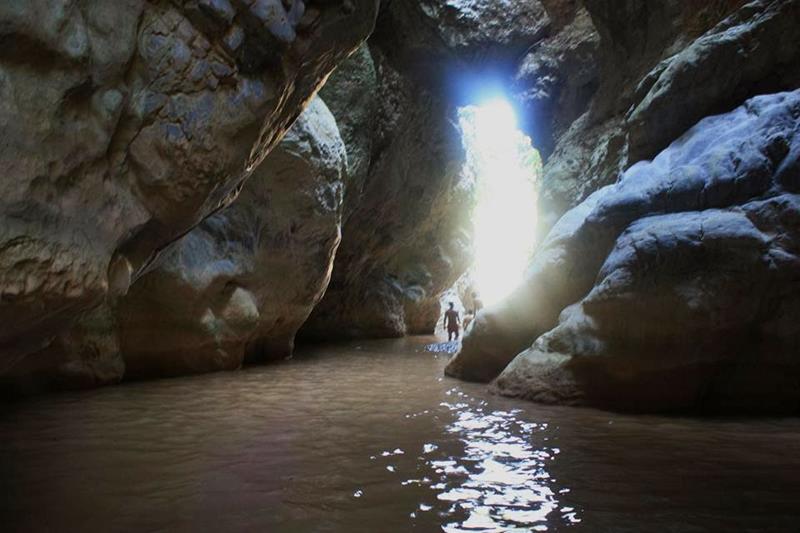
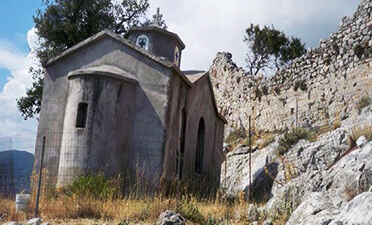
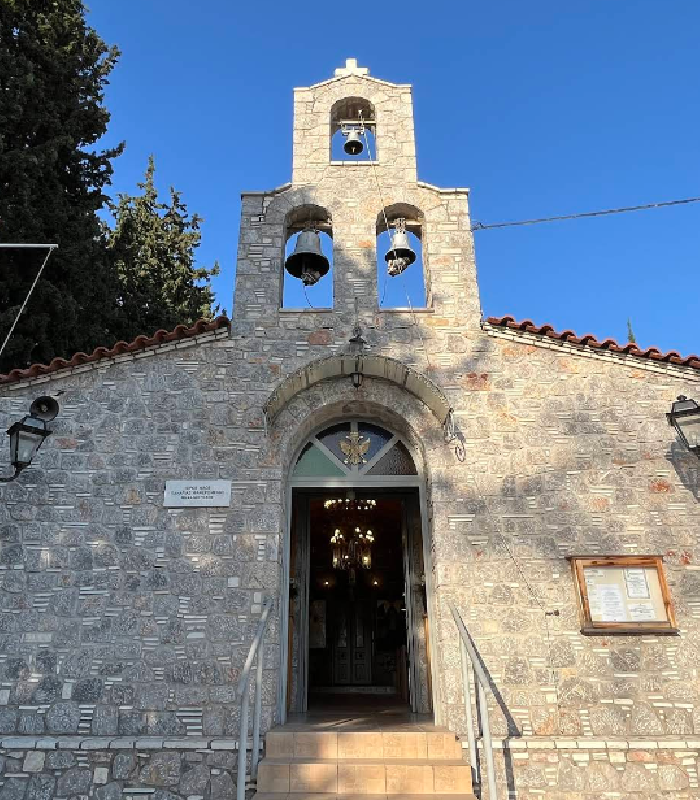
“Skotini Cave” is a cave located in the “kakalitsa” position almost at the top of the side of a steep and unusually beautiful gorge of a limestone mountain with a height of 440 meters. At the top of the mountain on the other side of the ravine is a ruined Venetian tower, at the foot of which is built the beautiful old chapel of “Aionikolas”, which was recently renovated on the initiative of doctor Nikos Giannoulis and inaugurated by Metropolitan Seraphim of Karystia and Skyros. The overall picture of the ravine, the two peaks – Kakalitsa and Aionikola – and the stream of chondros, is spectacular and the majesty of the landscape is impressive.
Skotini was a cave known to the inhabitants of Tharrouni since the area was inhabited, but it was officially discovered in 1974 and explored by the doctor and researcher Theodoros Skouras. Then on June 30, 1986, an archaeological excavation began, under the supervision of the curator of antiquities of Chalkida, Mr. Adamantios Samson, with the cooperation of the Ephorate of Paleoanthropology and Speleology. This excavation by Greeks was unusual in Greek data for two reasons. The first was that the cave has dimensions of 62×60 meters, which served as a dwelling from the Neolithic times at least, and the second – which added interest to the case – that it was financed by the small and poor village, with the support of the Tharrounians and the Cultural Educational and Recreational Association of the “Progress”.
Inside Skotini, fauna of the Pleistocene period was discovered when the Middle Paleolithic man lived, who was a hunter of wild prehistoric animals. Bones of many animals were also found, including a fossilized femur, belonging to the Semi-Arthian Hellenopithecus, which lived a million years ago and is more advanced than the Druopithecus and Mesopithecus, whose representatives have been found in Greece (Macedonia, Pikermi, etc.). In the cavities of the rocks were found fire hearths of the cavemen and items of cultic nature (vases and clay figurines), which testify that the cave of Skotini was a place of worship and burial of the dead. A number of finds from the period 5300-3400 BC and two human skeletons from the Neolithic period were brought to light. A rare imprint of a fabric or embroidery on a shell, as well as impressions of a basket lattice at the base of large unpainted vases, were also found.
It is worth noting that tools, millstones and pottery shells were found outside the cave area, showing signs of a Neolithic settlement. This settlement next to the cave reveals that ‘Skotini’ in Neolithic times was used as a residence, seasonally or occasionally. In approximately the same area outside the cave, a tool of the Middle Palaeolithic period was also found, which is an indication that in deeper layers of the cave there must be traces of habitation from Palaeolithic times, which, if verified, would mean that Skotini was also used as a permanent residence.












Leave a Reply